
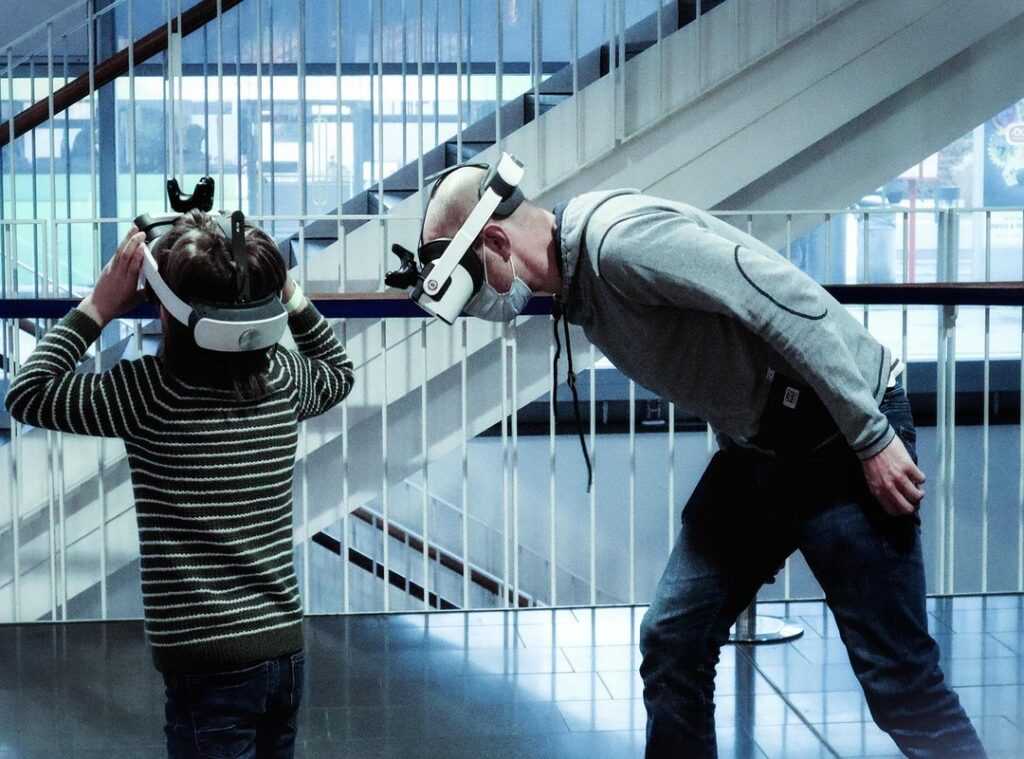
Getting lost in a game world is a feeling we all crave, right? Time melts away. The buzzword “immersion” gets thrown around a lot, but what does it really mean in gaming?
It’s not just about fancy graphics or soundtracks. It’s the technical and creative magic under the hood. I’ve spent years dissecting these layers, peeling back the curtain on what makes virtual reality gaming truly immersive.
Trust me, there’s more to it than meets the eye. Stick around and I’ll break down the key pillars of immersive gaming. You’ll gain a fresh perspective on appreciating your favorite games.
Immersion in Gaming: Beyond the Graphics
When people talk about immersion in games, they often think it’s all about stunning, photorealistic visuals. But let me tell you, immersion is much deeper than just eye candy. It’s about the feeling of being truly present in the game world, that hard to find “flow state” where you’re not just playing but living the game.
Ever felt so engrossed in a game that you lost track of time? That’s what we’re talking about.
Let’s break it down. First, there’s spatial immersion. This is where you feel like you’re physically in the game.
Think of the detailed world of Red Dead Redemption 2. It’s not just about graphics. It’s the consistent world rules and detailed environment that sell the experience.
Then there’s narrative immersion. This is when a story grabs you by the heartstrings. Remember the emotional journey in The Last of Us?
The characters become real, their struggles your own.
Finally, systemic immersion. This one’s for the mechanics geeks. You dive into the systems, mastering them until they become second nature.
Games like Factorio or the strategic combat in a soulslike pull you into this zone.
Now, you might be wondering, where does virtual reality gaming fit in? Well, it enhances every aspect of immersion, pushing boundaries further. If you’re curious about how indie games are shaking things up, check out the Rise Indie Games 2023.
Immersion in gaming is a multi-layered experience, and it’s evolving fast.
The Backbone of Immersive Worlds: Tech That Transforms
When we talk about visual fidelity, it’s not just pixels and polygons anymore. It’s about how ray tracing brings light into a game world (literally). This tech creates realistic lighting and reflections, making digital worlds feel almost touchable.
And let’s not forget refresh rates. High refresh rates and low latency are non-negotiable. They keep the illusion unbroken, ensuring reality stays smooth.
Now, let’s touch (quite) literally. On haptic feedback. Remember when controller rumble was the height of gaming excitement?
Those days are long gone. The PS5’s DualSense has changed the game (pun intended). Feel the bowstring’s tension or the gritty texture of a surface?
That’s next-level engagement. It connects your senses to the game world. It’s no longer just about watching; it’s about feeling too.
But what’s a game world without life? Enter advanced AI and world generation. NPCs (non-playable characters for the uninitiated) now behave in unpredictable, lively ways.
They’re not just following scripts. Sophisticated AI makes worlds lively and changing. Need proof?
Think of games where AI can adapt and surprise you. It’s not scripted. It’s spontaneous.
Procedural generation, on the other hand, crafts worlds that stretch beyond horizons. Imagine a universe where every corner hides something new. It’s not just a backdrop; it’s a character in its own right.
You explore, you discover. Sounds like a good time, right? That’s because it is.
And if you want to see all these tech marvels in action, dive into virtual reality gaming. It’s the frontier where reality and digital meet, inviting you to step into worlds like never before.
So, what’s next for immersive tech? Only time will tell. But as tech geeks, we’re here for it.
Always.
The Unseen Architects: How Audio and Story Build Your World
When it comes to virtual reality gaming, we often drool over graphics. But let’s be honest, audio is the real game-changer. It’s the key role of sound design that often gets overlooked.

Ever wondered why some games pull you in while others fall flat? It’s because sound can create a world more immersive than any pixelated vista. Take Hellblade: Senua’s Sacrifice for example.
This game uses binaural audio to simulate mental illness. You hear voices in your head, and it’s unnerving (in the best way). It’s not just about hearing footsteps; it’s about feeling them crawl up your spine.
Now, changing and adaptive music is another unsung hero. Imagine you’re exploring a serene space, and suddenly, the music shifts. Combat music kicks in.
Your pulse quickens. Without even realizing it, you’re more engaged. This isn’t just about soundtracks.
It’s about guiding emotions, enhancing presence. The music reacts to you, not the other way around.
But let’s not forget environmental storytelling. The best games don’t just feed you a story through cutscenes. They let you live it.
Items scattered in a room, the layout of a level, the architecture around you (these) elements tell stories. They create worlds where your actions matter. They’re not just backdrops.
They’re narratives.
And this is where player agency comes into play. Games that allow meaningful choices give you a sense of belonging and impact. Your decisions change the world, the narrative.
It’s not just about playing a game. It’s about being part of one.
Curious about how these elements might evolve? Check out the future of cloud gaming. It’s an exciting time, and these unseen architects will only become more key as gaming tech advances.
The Future is Now: Peering into the Next Generation of Immersion
Let’s talk about virtual reality gaming. It’s not just about putting on a headset anymore. The future is about immersion.
But what does that even mean? Imagine a world where cloud technology eliminates loading screens. You step into a game, and it just goes on forever.
No breaks, no pauses. This is what smooth worlds are all about. It’s like stepping into the “metaverse” (a term that’s getting thrown around a lot these days).
But can we even achieve that yet?
Then there’s AI. We’re not talking about smarter enemies that just dodge better. We’re talking about AI that creates entire plotlines on the fly.
Your actions dictate the story. If you think about it, that could redefine what it means to play a game. What if the game changes every time you play?
Sounds wild, right?
Now, let’s step into the sensory frontier. Haptic feedback is cool, but what if you could feel everything in a game? And I mean everything.
VR is headed (beyond) just sight and sound. And the real kicker? Brain-Computer Interfaces.
Yeah, it sounds like sci-fi, but people are working on this right now. Imagine controlling a game with your mind. It’s the ultimate endpoint for immersion.
But is it even possible in our lifetime?
Mistakes have been made in the past (remember 3D TVs?). But the lessons learned have made the dream of full immersion more tangible. Will we get there?
Only time will tell.
Unlocking Your Next Gaming Adventure
Finding your next unforgettable gaming journey isn’t just a quest; it’s about recognizing the magic in virtual reality gaming. Immersive experiences come from a fusion of tech and creativity. We all crave that deep dive into a world that feels alive.
You know what I’m talking about, right? Think back to that one game you couldn’t put down. Now, ask yourself: why was it so special?
Identify those elements. You’re not alone in this. Take action now.
Dive into new games with a discerning eye. Discover what sets them apart. Ready to start your next adventure?
Go explore.
 There is a specific skill involved in explaining something clearly — one that is completely separate from actually knowing the subject. Ardath Biblecons has both. They has spent years working with civiliden multiplayer engine analysis in a hands-on capacity, and an equal amount of time figuring out how to translate that experience into writing that people with different backgrounds can actually absorb and use.
Ardath tends to approach complex subjects — Civiliden Multiplayer Engine Analysis, Controller Setup Hacks, Core Gaming Mechanics and Tips being good examples — by starting with what the reader already knows, then building outward from there rather than dropping them in the deep end. It sounds like a small thing. In practice it makes a significant difference in whether someone finishes the article or abandons it halfway through. They is also good at knowing when to stop — a surprisingly underrated skill. Some writers bury useful information under so many caveats and qualifications that the point disappears. Ardath knows where the point is and gets there without too many detours.
The practical effect of all this is that people who read Ardath's work tend to come away actually capable of doing something with it. Not just vaguely informed — actually capable. For a writer working in civiliden multiplayer engine analysis, that is probably the best possible outcome, and it's the standard Ardath holds they's own work to.
There is a specific skill involved in explaining something clearly — one that is completely separate from actually knowing the subject. Ardath Biblecons has both. They has spent years working with civiliden multiplayer engine analysis in a hands-on capacity, and an equal amount of time figuring out how to translate that experience into writing that people with different backgrounds can actually absorb and use.
Ardath tends to approach complex subjects — Civiliden Multiplayer Engine Analysis, Controller Setup Hacks, Core Gaming Mechanics and Tips being good examples — by starting with what the reader already knows, then building outward from there rather than dropping them in the deep end. It sounds like a small thing. In practice it makes a significant difference in whether someone finishes the article or abandons it halfway through. They is also good at knowing when to stop — a surprisingly underrated skill. Some writers bury useful information under so many caveats and qualifications that the point disappears. Ardath knows where the point is and gets there without too many detours.
The practical effect of all this is that people who read Ardath's work tend to come away actually capable of doing something with it. Not just vaguely informed — actually capable. For a writer working in civiliden multiplayer engine analysis, that is probably the best possible outcome, and it's the standard Ardath holds they's own work to.